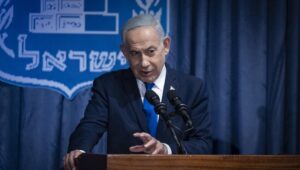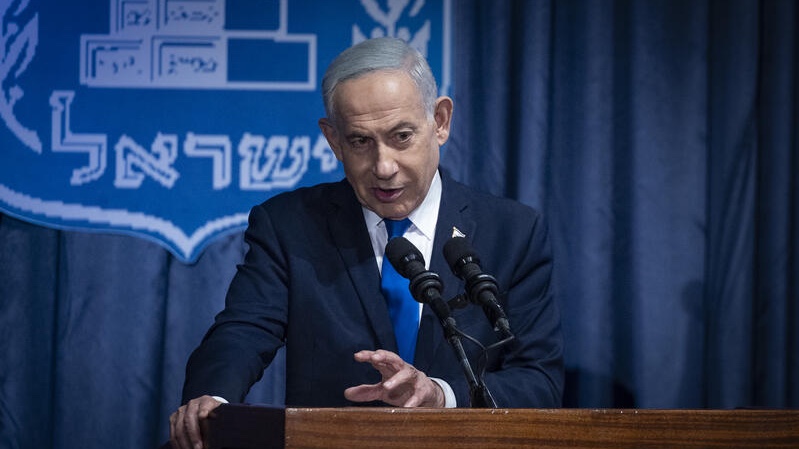
Benjamin Netanjahu bewahrt in seinem Büro Modelle eines Merkava-Panzers und eines F-35-Kampfjets auf. Daneben liegt eine Bibel.
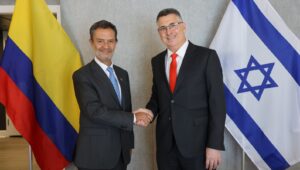
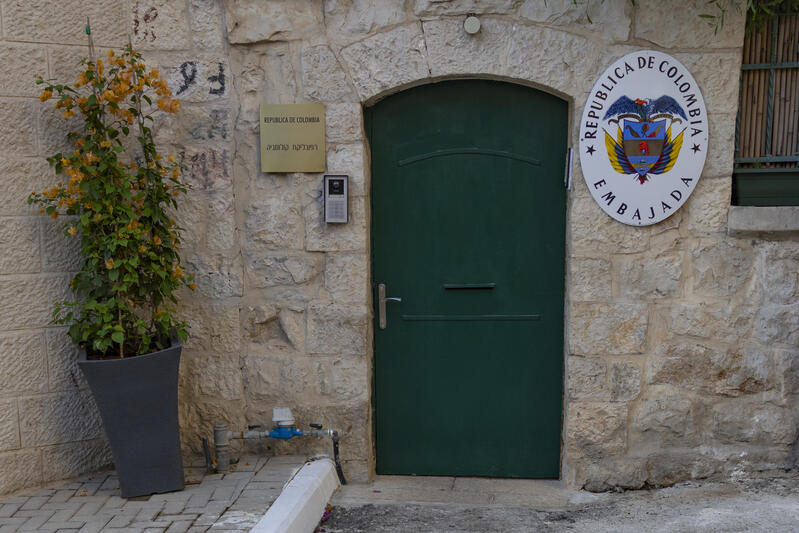
Am Mittwochabend erklärte er diese Anordnung bei einem Empfang im Außenministerium anlässlich der Eröffnung der kolumbianischen Botschaft in Jerusalem, die am selben Tag stattgefunden hatte.
„Stärke und Glaube … Das ist es, was unsere Zukunft bestimmt und schützt“, sagte der Ministerpräsident. Er fügte hinzu, dass Israel genau dies in sein Bündnis mit Kolumbien einbringe.
Prime Minister Benjamin Netanyahu’s Remarks at the Ministry of Foreign Affairs Reception Celebrating the Inauguration of the Embassy of Colombia in Jerusalem:
“Thank you to the Ambassador of Israel to Colombia, and the Ambassador of Colombia to Israel. And dear ambassadors, dear friends, in so many countries, in so many continents.I’m going to tell you something that will absolutely shock you. I’ve been prime minister for a while, you know. And in 2017, I discovered an amazing fact. No sitting prime minister of Israel in almost 70 years of our history ever went south of Texas. That’s as far south as we got. And I said, well, that’s impossible. And I checked. It was true. No sitting prime minister of Israel went south of the Rio Grande.
So I decided we have to change that. It’s all of Latin America. It’s a huge chunk of humanity, a huge and important part of the world. And I thought, okay, I’ll go.
And the first place we went to, Sara and I, three places: Colombia, Argentina and Mexico. It was a great visit, very friendly in every one of these countries. And by the way, a year later, I think we went to a small country called Brazil, to the inauguration of President Bolsonaro. Who knows? We may do it again.
And not accidentally, a year later, 2017, I think, or 18, my wife, Sara, led a delegation of the Foreign Ministry, not to an earthquake, which we just did again in Colombia, but to a volcanic eruption in Guatemala. And she led a mission of mercy and assistance to the children of Guatemala, and the creation of a neighborhood called New Jerusalem. Douze points. Exactly.
So there are these deep connections that went awry, they were completely derailed because in Argentina, in Mexico, in Brazil, and I regret to say in Colombia, there was a new pharaoh, pharaohs, who did not know Joseph or Gideon or Benjamin, and it all went down to the global woke alliance. It just went down and down and down.
And now I have to tell you that something remarkable is happening in Latin America. It’s all coming back. It’s all coming back. The great friendship, the great sympathy, the deep sympathy between our peoples. A real friendship. It’s based on, yes, interests. I’ll talk about that in a minute. But it comes from the heart. It comes from values. And I have to say that President Abelardo de la Espriella said it exactly, and you said it, Omar, exactly. It’s a common heritage. A Judeo-Christian heritage that started in this city, this city. The city of the prophets, the king of Israel, the city of Christianity. This is where it all began. and it forms a very strong bond between our peoples. Not only the past, but seizing the future.
We want to seize the future together with security, with agriculture, with water, with AI, with everything, with everything. We want to make it grow, not only the crops, the people, the children. Give hope. This is what we’re about.
We’re about life and hope, and we face, exactly as was said here, a death cult that has gripped parts of the globe. A battle of civilization against barbarism. We stand for civilization. We stand for life. We stand for hope. And we’re willing to fight the barbarians.
And we appreciate those who stand with us. And Colombia stands with us. Great courage, great courage and foresight of your president. Please send him my warmest regards. We spoke on the phone. But yes, I’d love to visit with Sara, Colombia again, Bogota. You have a beautiful country, beautiful people, and you deserve the future that you now will get.
You have no better friend than Israel. We believe that we have no better friend than Colombia.
And some great friends who are here as well. I appreciate the support from countries in Africa, countries in Latin America, countries elsewhere. Our friend, the United States of America, President Trump did a great thing here.
So to have the 10th Embassy, the 10th Embassy, the minyan, is a great thing. That’s a great development.
And Sara and I want to visit. We hear it’s spectacular. We want to visit your embassy. If we can do so in the coming days, I’d appreciate it. We’ll let you know. We want to come.
So thank you. Thank you, Colombia, for this friendship.
And I can say that there’s no better place to celebrate it than in Jerusalem, because it has been the pulsating heart of the Jewish people for three millennia. It’s our past, it’s our future, it’s our hope, it’s our faith.
And I want you to know that in many ways, when people come to my office, I have a map of the world, not big enough because it encompasses only parts of Africa and the Middle East and Europe. I want to give now an instruction to my staff: Please change it. Put a map that includes Latin America. Please do it, all of Africa and all of Asia, because the world is coming back.
But I think that they see two other things below the map. They see a small model of the Merkava tank, an F-35. I call it power. And then they see right next to it a copy of the Bible. That’s called faith. Power and faith. That is what governs our hopes. That is what governs and protects our future. And that is what we bring to our alliance together with you, Colombia.
Thank you, Colombia, and congratulations on a wonderful, powerful move of power, courage, and faith.
Thank you to the ambassador of Israel to Colombia, and the ambassador of Colombia to Israel. And dear ambassadors, dear friends, in so many countries, in so many continents.
I’m going to tell you something that will absolutely shock you. I’ve been prime minister for a while, you know. And in 2017, I discovered an amazing fact. No sitting prime minister of Israel in almost 70 years of our history ever went south of Texas. That’s as far south as we got. And I said, well, that’s impossible. And I checked. It was true. No sitting prime minister of Israel went south of the Rio Grande.
So I decided we have to change that. It’s all of Latin America. It’s a huge chunk of humanity, a huge and important part of the world. And I thought, okay, I’ll go.
And the first place we went to, Sara and I, three places: Colombia, Argentina and Mexico. It was a great visit, very friendly in every one of these countries. And by the way, a year later, I think we went to a small country called Brazil, to the inauguration of President Bolsonaro. Who knows? We may do it again.
And not accidentally, a year later, 2017, I think, or 18, my wife, Sara, led a delegation of the Foreign Ministry, not to an earthquake, which we just did again in Colombia, but to a volcanic eruption in Guatemala. And she led a mission of mercy and assistance to the children of Guatemala, and the creation of a neighborhood called New… Jerusalem. Douze points. Exactly.
So there are these deep connections that went awry, they were completely derailed because in Argentina, in Mexico, in Brazil, and I regret to say in Colombia, there was a new pharaoh, pharaohs, who did not know Joseph or Gideon or Benjamin, and it all went down to the global woke alliance. It just went down and down and down.
And now I have to tell you that something remarkable is happening in Latin America. It’s all coming back. It’s all coming back. The great friendship, the great sympathy, the deep sympathy between our peoples. A real friendship. It’s based on, yes, interests. I’ll talk about that in a minute. But it comes from the heart. It comes from values. And I have to say that President Abelardo de la Espriella said it exactly, and you said it, Omar, exactly. It’s a common heritage. A Judeo-Christian heritage that started in this city, this city. The city of the prophets, the king of Israel, the city of Christianity. This is where it all began. and it forms a very strong bond between our peoples. Not only the past, but seizing the future.
We want to seize the future together with security, with agriculture, with water, with AI, with everything, with everything. We want to make it grow, not only the crops, the people, the children. Give hope. This is what we’re about.
We’re about life and hope, and we face, exactly as was said here, a death cult that has gripped parts of the globe. A battle of civilization against barbarism. We stand for civilization. We stand for life. We stand for hope. And we’re willing to fight the barbarians.
And we appreciate those who stand with us. And Colombia stands with us. Great courage, great courage and foresight of your president. Please send him my warmest regards. We spoke on the phone. But yes, I’d love to visit with Sara, Colombia again, Bogota. You have a beautiful country, beautiful people, and you deserve the future that you now will get.
You have no better friend than Israel. We believe that we have no better friend than Colombia.
And some great friends who are here as well. I appreciate the support from countries in Africa, countries in Latin America, countries elsewhere. Our friend, the United States of America, President Trump did a great thing here.
So to have the 10th Embassy, the 10th Embassy, the minyan, is a great thing. That’s a great development.
And Sara and I want to visit. We hear it’s spectacular. We want to visit your embassy. If we can do so in the coming days, I’d appreciate it. We’ll let you know. We want to come.
So thank you. Thank you, Colombia, for this friendship.
And I can say that there’s no better place to celebrate it than in Jerusalem, because it has been the pulsating heart of the Jewish people for three millennia. It’s our past, it’s our future, it’s our hope, it’s our faith.
And I want you to know that in many ways, when people come to my office, I have a map of the world, not big enough because it encompasses only parts of Africa and the Middle East and Europe. I want to give now an instruction to my staff: Please change it. Put a map that includes Latin America. Please do it, all of Africa and all of Asia, because the world is coming back.
But I think that they see two other things below the map. They see a small model of the Merkava tank, an F-35. I call it power. And then they see right next to it a copy of the Bible. That’s called faith. Power and faith. That is what governs our hopes. That is what governs and protects our future. And that is what we bring to our alliance together with you, Colombia.
Thank you, Colombia, and congratulations on a wonderful, powerful move of power, courage, and faith.
Thank you. Thank you all.”
Video: GPO
— Prime Minister of Israel (@IsraeliPM) October 14, 2026
Eine Kehrtwende, die sich seit zwei Jahren anbahnte
Kolumbien eröffnete am Mittwoch seine Botschaft in Jerusalem und wurde damit zum zehnten Land, das diesen Schritt vollzog. Der neue Präsident Abelardo de la Espriella machte den Bruch seines Vorgängers mit Israel rückgängig und setzte auch ein Freihandelsabkommen zwischen den beiden Ländern wieder in Kraft.
Vor nicht allzu langer Zeit wäre dies kaum vorstellbar gewesen. Der frühere Präsident Gustavo Petro brach im Mai 2024 wegen des Krieges im Gazastreifen die Beziehungen zu Israel ab, schloss anschließend die kolumbianische Botschaft in Tel Aviv und berief den Botschafter zurück. Später kündigte Petro Pläne für eine Botschaft in Ramallah an. Sie wurde jedoch nie eröffnet.
De la Espriella hatte die Verlegung der Botschaft nach Jerusalem zu einem Wahlversprechen gemacht. Außenminister Gideon Sa’ar erklärte, er habe de la Espriella im November 2025, noch vor der Wahl, in Buenos Aires getroffen. Der spätere Präsident habe damals zugesagt, die Botschaft zu verlegen. Sa’ar wies darauf hin, dass sie zwei Monate nach dessen Amtsantritt eröffnet wurde. Seine Regierung hat außerdem Petros Verbot von Kohleexporten aufgehoben, Schritte zum Rückzug aus dem von Südafrika angestrengten Verfahren gegen Israel vor dem Internationalen Gerichtshof eingeleitet und die Haager Gruppe verlassen.
Der kolumbianische Außenminister Omar Bula Escobar erklärte, die Beziehungen „hätten niemals abgebrochen werden dürfen“.
Netanjahu bezeichnete die zehnte Botschaft als einen Minjan, das Quorum von zehn Personen, das für ein gemeinschaftliches jüdisches Gebet erforderlich ist.
Der Panzer ist keine Dekoration
De la Espriella hat erklärt, er wolle Zugang zu neuen Waffen, Drohnen und künstlicher Intelligenz aus Israel und den Vereinigten Staaten erhalten. Während des Wahlkampfs sagte er außerdem, er werde eine engere Zusammenarbeit mit Israel im Kampf gegen Guerillagruppen anstreben, die durch den Drogenhandel finanziert werden. Netanjahu nannte Sicherheit, Landwirtschaft, Wasser und künstliche Intelligenz als Bereiche, in denen beide Länder gemeinsam wachsen könnten.
Kolumbien eröffnet seine Botschaft nicht allein aus emotionaler Verbundenheit. Das Land will das, wofür der Merkava und die F-35 stehen: einen Staat, der sich selbst verteidigen kann und seinen Freunden hilft, dasselbe zu tun.
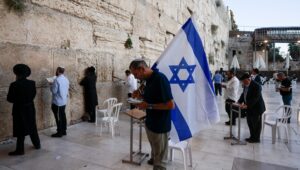
Die andere Hälfte der Formel, der „Glaube“, ist Jerusalem selbst. Netanjahu beschrieb die Stadt als das Zentrum der jüdischen nationalen Identität seit dreitausend Jahren und bezeichnete sie als Vergangenheit, Zukunft, Hoffnung und Glauben des jüdischen Volkes.
Streitwagen und Pferde
Manche Leser werden hören, dass Bibi Panzer und die Heilige Schrift in einem Atemzug erwähnt hat, und dabei an Psalm 20 denken: „Diese verlassen sich auf Wagen und jene auf Rosse, wir aber gedenken des Namens des HERRN, unseres Gottes.“
Doch Psalm 20 ist ein Gebet für einen König am Tag der Schlacht. Eine Schlacht, die er und sein Heer dennoch kämpfen müssen. Der Psalm stellt die Frage, worauf der König sein Vertrauen setzt. Und genau mit dieser Frage ringt Israel weiterhin.
Eine noch passendere Parallele findet sich bei Nehemia. Als die aus dem Exil zurückgekehrten Juden unter Bedrohung die Mauern Jerusalems wiederaufbauten, schrieb Nehemia: „Da beteten wir zu unserem Gott und stellten Wachen gegen sie auf, bei Tag und bei Nacht“ (Nehemia 4,3; Schlachter 2000). Die Bauleute arbeiteten mit der einen Hand und hielten mit der anderen eine Waffe.
Sa’ar griff ein ähnliches Bild auf, als er zu de la Espriella sagte: „Sie haben einen Stein in die Mauern Jerusalems eingefügt.“
Lateinamerika bringt die Waage zum Kippen
Palästinensische Vertreter verurteilten die Einweihung umgehend und verwiesen darauf, dass die meisten Staaten die israelische Souveränität über ganz Jerusalem weiterhin nicht anerkennen.
Doch die Gewichte verschieben sich. Und Lateinamerika spielt bei dieser Kehrtwende eine wichtige Rolle.
Kolumbien ist nach Guatemala, Honduras und Paraguay das vierte lateinamerikanische Land mit einer Botschaft in Jerusalem. Damit entfallen inzwischen vier der zehn Botschaften auf diese Region.
Bald könnten es noch mehr werden. Argentiniens Präsident Javier Milei hat versprochen, seine Botschaft nach Jerusalem zu verlegen, und erklärt, die Entscheidung sei endgültig. Die Verlegung wurde im Januar wegen eines Streits im Zusammenhang mit israelischen Geschäftsaktivitäten auf den Falklandinseln verschoben. In Brasilien hat Flávio Bolsonaro zugesagt, die Botschaft innerhalb von sechs Monaten zu verlegen, falls er die Stichwahl am 25. Oktober gewinnt.
Sollten beide ihre Versprechen einlösen, würde die Hälfte der Botschaften in Jerusalem lateinamerikanischen Ländern gehören.